
 Science
On the night of 3 July 1899, a storm crossed the plateau east of Colorado Springs. Tesla watched carefully through an electrical detector. In his notes the next day, he estimated that 10,000 to 12,000 lightning discharges had occurred within two hours. He also noted that the instrument kept responding after the storm had moved beyond sight.
The scene is actually more revealing than the familiar portrait of Tesla alone with his famous coil. He looked at landscape-scale forces, like gravity-propelled water, powerful thunderstorms, and the Earth's electrical field.
His fascination brought him to some of Earth's most beautiful landscapes. This article explores three important places in Tesla's journey: Smiljan, Croatia, beneath the Velebit massif, Niagara Falls, on the border between the USA and Canada, and Colorado Springs, USA. Without being an electricity enthusiast, you can still appreciate the natural beauty and give a bit of thought to the great inventor they inspired.
Smiljan: A Stormy Start
Tesla was born at midnight between 9 and 10 of July, 1856, in Smiljan, Croatia, in a parish house beside the local Orthodox church. He began school in the village before the family moved to nearby Gospić in 1863. The restored house and its grounds now form the Nikola Tesla Memorial Center.
The Center's timeline repeats the famous detail that lightning crossed the sky on the night of his birth. It is an irresistible scene, to be sure, but Tesla's success was more than just divine intervention. He credited his mother, Đuka, with a talent for making household devices and his father, Milutin, with exercises that trained his memory and powers of observation.
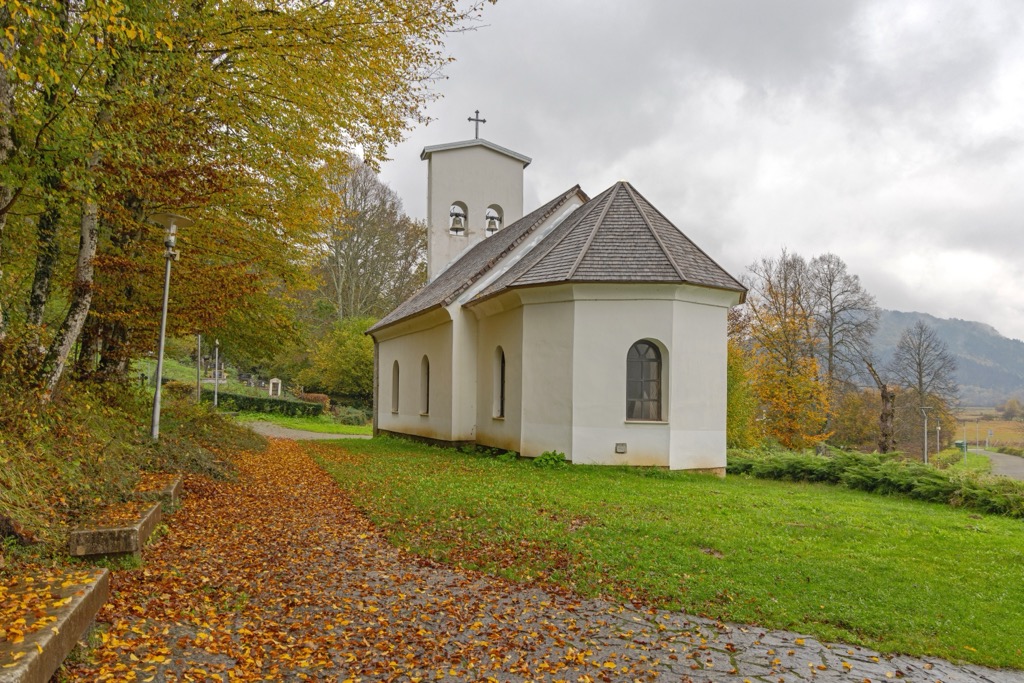
 On the map Nikola Tesla Memorial Center, Smiljan →
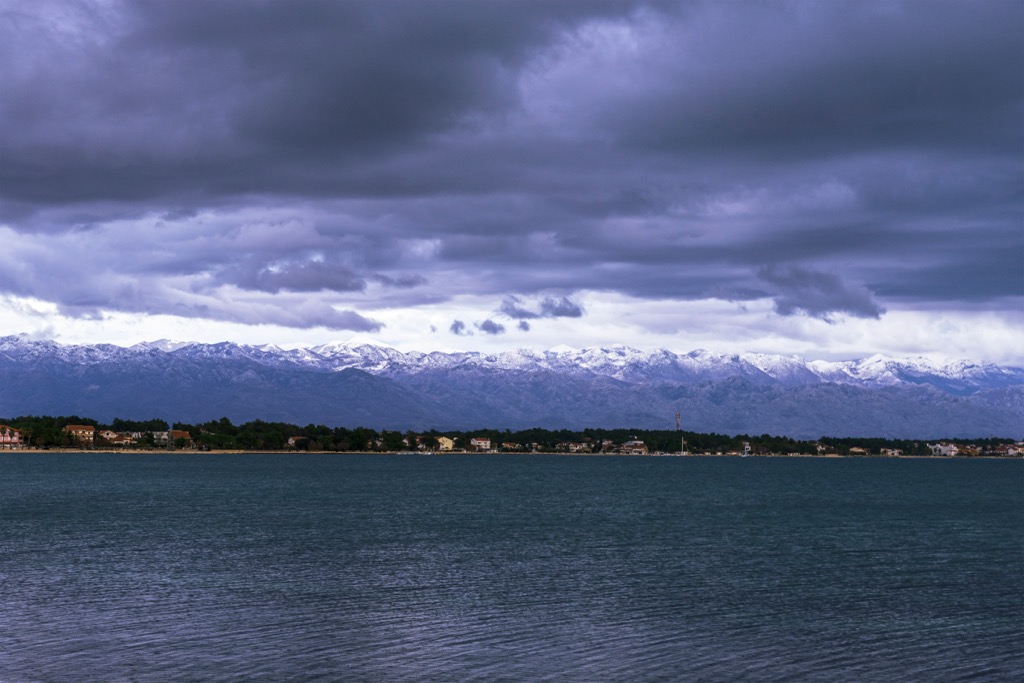
Meanwhile, the neighboring Velebit Massif in Croatia forms a long wall of limestone and forest, and is no stranger to rapidly changing weather. It forms the horizon of Tesla's birthplace. It's one of the reasons why Tesla was born on a stormy night — the mountains are subject to much thunderstorm activity during summer. There is no particular summit or route here to turn into a Tesla milestone — but it's a great nearby hiking destination to visit in conjunction with Tesla's birthplace!
Niagara: Working the Water Wheel
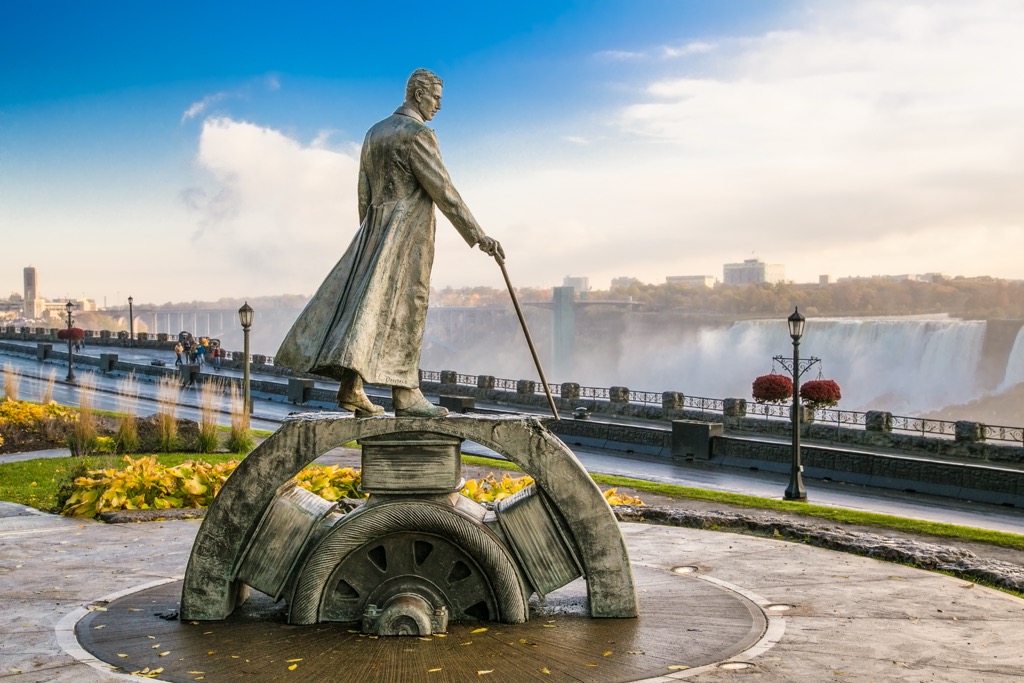
In the autobiography he published in 1919, Tesla recalled seeing an image of Niagara Falls as a boy and imagining a wheel driven by its water. How could movement in a landscape become useful movement in a machine?
Generator No. 1 at the Edward Dean Adams Station began operating on August 26, 1895. By 1896, electricity generated at Niagara was transmitted to Buffalo, NY. Westinghouse equipment used the polyphase alternating-current (AC) system developed through Tesla's patents.
The achievement was collective. Edward Dean Adams organized the project, George Forbes advised it, and Westinghouse and General Electric built major parts of the system. Tesla's patents were fundamental, but he was neither the sole designer of the plant nor the inventor of hydroelectric power. But when he visited on 19 July 1896, the wheel of his childhood had become reality.
A visit to Niagara Falls will not disappoint. As one of the world's largest falls by volume, surely Tesla was as impressed with their natural power as he was with the new hydroelectric station.
Colorado Springs: Listening to Lightning
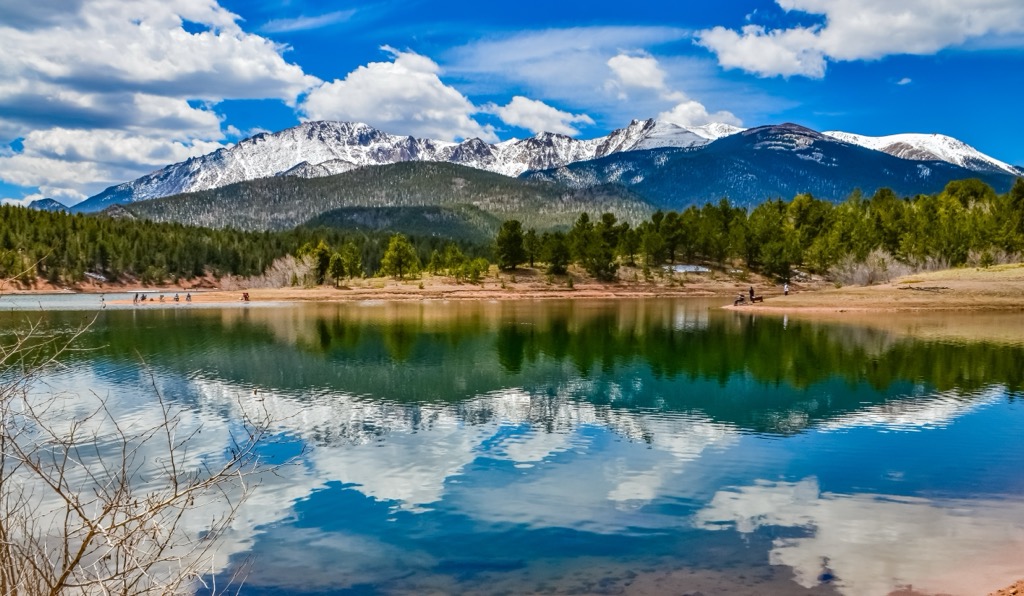
Colorado Springs, USA, is subject to many thunderstorms during the summer monsoon. The city wondered whether the electrical behavior of the atmosphere could become part of another system, one which would directly benefit humans. Tesla arrived in 1899 and built an experimental station on the high plateau east of the city, with Pikes Peak and the Front Range on the western horizon.
The location offered an unusually clear atmosphere and frequent electrical storms. From May 1899 to January 1900, Tesla worked with high-voltage, high-frequency currents, resonance, and wireless signaling in an effort to harness the power of lightning. He listened for natural lightning through his instruments and recorded the experiments in his notebooks, now known as the Colorado Springs Notes.
In the end, the work was somewhat of a failure. A laboratory discharge damaged the local power company's equipment, although there is no evidence for the later story that Tesla blacked out the whole city. His experiments did not produce a completed system for transmitting useful power without wires. He left Colorado Springs with unpaid bills, and the abandoned building was eventually sold for lumber.
While no longer a beacon of experimental energy, the Front Range of Colorado is one of the great destinations of North America. The entire range is home to endless hiking, biking, climbing, and, during winter, skiing. A warning in advance, though: summer thunderstorms occur on most afternoons, and getting struck by lightning is a real risk high in the mountains!
Sources and Further Reading
- Nikola Tesla's early life — Memorial Center Nikola Tesla, Smiljan
- My Inventions — Nikola Tesla's 1919 autobiography
- The Origins of Hydroelectric Power — U.S. National Park Service
- Westinghouse Niagara Falls generator, 1895 — Smithsonian
- Niagara Falls — Tesla Science Center at Wardenclyffe
- Colorado Springs Laboratory — Nikola Tesla Museum
- Nikola Tesla in Colorado Springs — Colorado Springs Pioneers Museum
- Colorado Springs Notes, 1899–1900 — Smithsonian Libraries